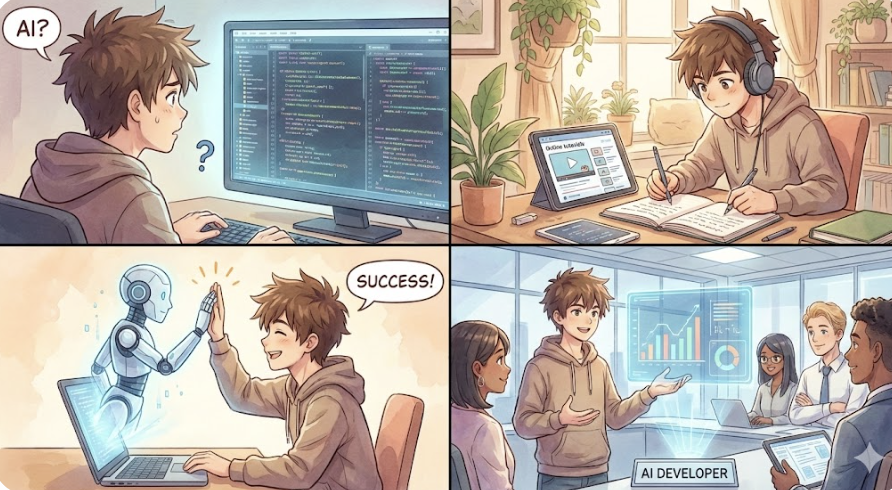
The Ripple Effect Is Already Here
Last Friday, Minister Josephine Teo announced Singapore will invest over $1 billion from 2025 to 2030 to boost public AI research capabilities and talent development. This adds to what the government already committed in Budget 2024: $4,000 in SkillsFuture credits for workers 40 and above, training allowances up to $72,000, and a Workforce Development Grant covering 70% of job redesign costs. https://www.asiaone.com/singapore/mddi-singapore-invest-over-1b-ai-research-plan-2030-josephine-teo Layer upon layer. This isn't generosity. It's urgency. After 15 years in HR, I've watched many workforce trends come and go. But what's happening now feels different. The signals from both global markets and our own government are pointing in the same direction: the window to prepare is shrinking fast. Two Forces Converging 1. MNCs are bringing talent back home. For decades, companies placed jobs wherever they could find the right skills at the right cost. Singapore benefited from that equation. But the variables are changing. AI doesn't just automate tasks, it compresses the talent gap. One employee with the right tools now delivers what used to take a team. Workflows that took months to build can be prototyped in days by someone who knows how to prompt an AI coding assistant. The person replacing your job isn't a robot. It's someone back in head office who just vibe-coded your entire workflow over a long weekend. For Singapore, this hits close to home. The regional HQ model that sustained our service economy assumed we'd always offer something harder to replicate: skilled professionals, regulatory stability, regional connectivity. But when MNCs can build AI-literate workforces in their home markets, supported by government incentives and cheaper compute, the math on maintaining large operations here starts to shift. 2. AI is eating operational roles faster than predicted. Goldman Sachs now estimates 6-7% of the US workforce faces displacement, with younger tech workers hit hardest—unemployment among 20-to-30-year-olds in tech-exposed roles has jumped nearly 3 percentage points since early 2025. The World Economic Forum projects 92 million jobs displaced globally by 2030, even as 170 million new ones emerge. The catch? Those new jobs don't replace the old ones neatly. They require different skills. They appear in different locations. And 77% of emerging AI roles currently ask for master's degrees. But here's what that headline misses: the fastest-growing demand isn't for AI PhDs. It's for what Minister Teo calls "AI bilingualists". People who already have domain expertise and add practical AI fluency on top. The accountant who can automate reporting workflows. The marketer who knows how to brief an AI tool. The HR professional who can redesign roles around human-AI collaboration. These skills don't require a graduate degree. They require intentional learning and practice. Back-office functions, operations teams, tech support, data entry, customer services, these are the first to go. Amazon's memo to staff was blunt: AI will "reduce our total corporate workforce as we get efficiency gains." Microsoft now writes 30% of its code with AI while laying off thousands of software engineers. The Waiting Problem Here's what concerns me most from my years in HR: we wait. We wait for our companies to tell us what skills to learn. We wait for government subsidies before we move. We wait until restructuring notices land on our desks. The government sees this too. That's why the subsidies keep growing. But as Minister Josephine Teo put it, AI is becoming "the new national language." And like any language, you can't cram it the night before. Skills take time to develop. I've seen this play out hundreds of times in hiring and training programmes. The gap between "I took a course" and "I can apply this to solve problems" is measured in months, sometimes years. Competence requires repetition, failure, iteration. But here's the mismatch: AI is moving in weeks. The tools that seemed experimental six months ago are now standard in workflows across industries. The ripple effect is real. It doesn't hit everyone at once. It starts with the roles furthest from customers and revenue: operations, admin, support. By the time it reaches the roles closer to the action, the people who adapted early have already secured the new opportunities. What Comes Next I'm not suggesting panic. I am suggesting honest assessment. Look at your current role. How much of what you do involves repetitive processing, data handling, or coordination tasks? Those are the functions AI handles well. How much involves judgment, relationship-building, or navigating ambiguity? Those remain human advantages, for now. The last wave always looks obvious in hindsight. The people who ride it are the ones who saw it coming.